Module 4 — Is the compression optimal?
The zero-collar compression beats the ordinary Petz map by exactly a factor four, and no quasi-free channel found anywhere beats it. That is not the same as being optimal. A first-order rotation inside B lowers the error by a measured factor 1 − θ, and this module shows where that number comes from, what is proved about it and what is only measured.
Per chirality the zero-collar compression gives Φ(z) = f₂z² + O(z³) against the ordinary Petz map's Φ(2z) = 4f₂z² + O(z³); for a 2D CFT, 2f₂z² against 8f₂z². The reason is structural: inside the rotated family the range constraint β(A(BC)) ⊆ A(B) is active exactly at the compression endpoint, and for a single chirality the family is monotone, so the ordinary Petz map is its worst admissible member.
Where this comes from: claim page · rigor/optimality_second_order.tex · fidelity_recovered_quasifree.tex
Gauge-invariant quasi-free channels have data (X, Y), completely positive iff Y ≥ 0 and XX* + Y ≤ 1. In the variables (X, Z = X QBB X* + Y) the feasible set is convex and semidefinite representable, the recovered symbol is affine in it and the SLD form gQ is a convex quadratic, so every local minimum is global. Two further theorems close the gap to all channels: every normal unital CP even map β: A(BC) → A(B) has a feasible symbol, and by a Sion minimax the dual value equals the quasi-free minimum — so the relaxation is tight, not merely an upper bound. The lower-bound side is an Alberti–Uhlmann single-observable bound; the upper-bound side is an exact Uhlmann construction whose exterior directions are invisible because cl(Ext) = N⊥.
Where this comes from: the SDP · every channel is feasible · all channels = quasi-free · the lower bound · the upper half · the exterior is invisible · why the A–C route gives nothing
In the continuum the two linear matrix inequalities are active, the multipliers are unique, and the compression maximises Tr(t Qrec) over the feasible set iff Σ₁ = Σ₁* ≥ 0 and Σ₁ + tDD ≥ 0 — necessary and sufficient, with no constraint qualification. Reducing it, the certificate at the compression exists precisely when ED u ED = 0. The measurement below says that quantity is not zero, so no certificate for f₂z² exists.
Where this comes from: claim page · rigor/sdp_dual_certificate.tex
That the isometric orbit carries the whole tangent optimum — that noise and isometry loss buy nothing — is not a theorem here. It rests on three hypotheses. (H1) and (H2) are the parametrisation and derivative conditions of the tangent problem; (H3) is the model-cone hypothesis, that the whole cone of admissible isometry generators reduces to two boundary directions. That reduction is proved for vector fields only: multiplicity > 1 shift semigroups and unbounded skew-adjoint multiplication operators escape the argument. Within those hypotheses the numerics exclude any O(1) gain from non-isometric directions — every measured gain falls like h1.85/Ymax², and the four values are in the last panel of this page — but they do not establish that the optimal noise vanishes, and the marginal case found here is exactly where uniqueness is not delivered.
Where this comes from: claim page · the exact parametrisation · the sign criterion · the criterion numerics · rigor/exact_optimum_tangent_problem.tex · numerics/optimality_all/F2_RESULTS.md
Four channels, one axis
The vertical axis is the second-order coefficient in units of f₂z², per chirality. The rotated family runs from the ordinary Petz map at λ = 0 down to the compression as λ → ∞; the optimum sits below the family, because it is not in it.
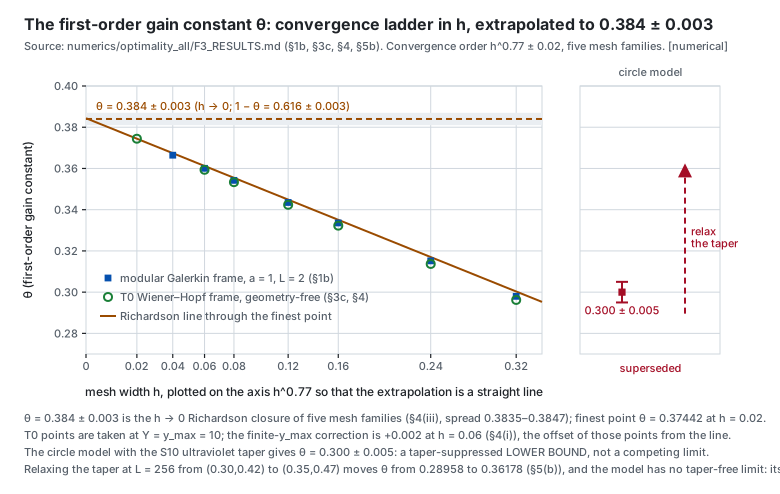
Where θ comes from: the mesh ladder
The horizontal axis is h0.77, the measured convergence order, so the extrapolation is a straight line and h = 0 is the left-hand edge. Two independent discretisations are drawn: the parameter-free T0 Wiener–Hopf frame and the modular Galerkin frame at a different geometry. They agree, which is what Möbius covariance requires.
The five families, and the number they close on
Each row is an independent ladder extrapolated by Richardson with its own measured ratio ρ. The spread over the families and fit windows below is where the quoted uncertainty comes from.
The criterion that is extrapolated, not verified
Condition (a) of the tangent problem asks for M* ≥ 0. At every finite mesh it fails. What is measured is that the violation and the gain a violating direction could buy both go to zero, with clean power laws — about h1.15 and h1.85. Both axes are logarithmic.
Claims this module carries
| claim | status |
|---|---|
| the compression beats the Petz map by four | proved |
| the quasi-free problem is a convex SDP | proved |
| every channel's symbol is feasible | proved |
| all channels equal quasi-free | proved |
| the single-observable lower bound | proved |
| the Uhlmann upper half | proved |
| the exterior directions are invisible | proved |
| the KKT certificate and EDuED | proved |
| the A–C lower bound is zero | proved |
| the exact tangent parametrisation | proved conditional on H1, H2 |
| the noise sign criterion | proved conditional on H1, H2, H3 |
| θ = 0.384 ± 0.003 | numerical |
| the compression is not the second-order minimiser | numerical |
| the criterion numerics | numerical conditional on H3 |
| the all-channel optimum (1−θ) f₂z² | numerical conditional on H1, H2, H3 |